
Hartblei Super-Rotators
A review of two extraordinary tilt-shift lenses from Kiev
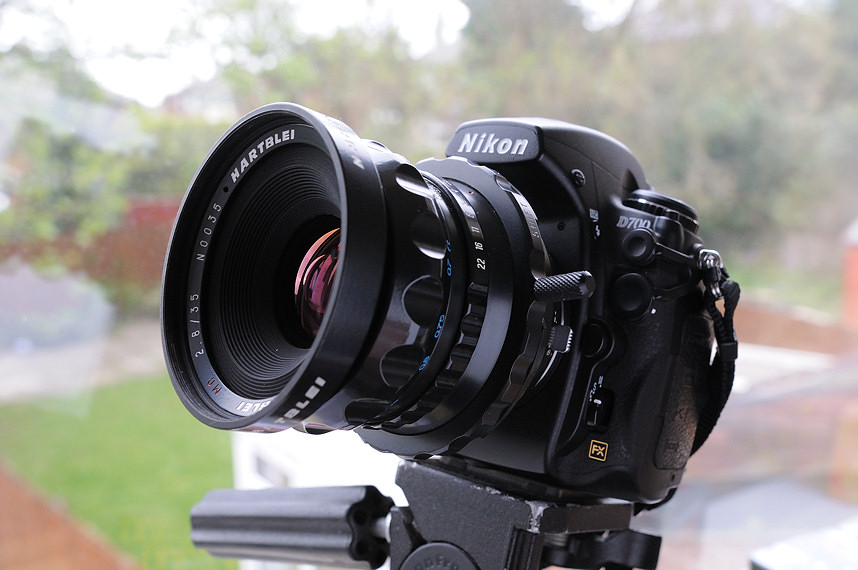
The first version of this article was posted in 2009. I'm updating with a few observations and images in 2014 whilst contemplating whether to sell these lenses.
Tilt and shift is an interesting area of photography, and the Hartblei Super-Rotator series of lenses are excellent tools for getting into this genre.
Providing the movements of view cameras, these lenses exceed the capabilities of the Nikon PC range of lenses by providing full 360 degree rotation, 8 degrees of tilt and 10 mm of shift. The 35mm and 80mm f/2.8 Super-Rotators are superb pieces of equipment. Solidly made, quality finishes, weight and sheer presence leave a good impression. They are all metal and glass with a heavy duty black satin lacquer finish and engraved and painted lettering. The dials and buttons are solid and resemble a Victorian machine.
Don't be put off by the Ukranian origins of this lens. The Nikon TS lenses cannot do what this lens does. The new range is enormously and outrageously expensive, but there were still copies going for £350-500 on eBay in late 2009 (new for £570). They are highly recommended!
Update: By 2014 copies of these lenses rarely appear on auction. The new Hartblei's are exceedingly expensive, and clearly aimed at a new market (wallet) of photographers.
Tilt and shift is an interesting area of photography, and the Hartblei Super-Rotator series of lenses are excellent tools for getting into this genre.
Providing the movements of view cameras, these lenses exceed the capabilities of the Nikon PC range of lenses by providing full 360 degree rotation, 8 degrees of tilt and 10 mm of shift. The 35mm and 80mm f/2.8 Super-Rotators are superb pieces of equipment. Solidly made, quality finishes, weight and sheer presence leave a good impression. They are all metal and glass with a heavy duty black satin lacquer finish and engraved and painted lettering. The dials and buttons are solid and resemble a Victorian machine.
Don't be put off by the Ukranian origins of this lens. The Nikon TS lenses cannot do what this lens does. The new range is enormously and outrageously expensive, but there were still copies going for £350-500 on eBay in late 2009 (new for £570). They are highly recommended!
Update: By 2014 copies of these lenses rarely appear on auction. The new Hartblei's are exceedingly expensive, and clearly aimed at a new market (wallet) of photographers.
PERFORMANCE
Aesthetics aside, performance is complicated. Photography with tilt-shift lenses is an art form and setting the different planes of focus in bright sunlight and the small viewfinders of digital SLRs is not easy. I found the mechanisms a bit stiffer than on the 35mm, though I am hoping these may loosen with use. The lack of electronic coupling and aperture coupling to the body is not a big deal, but it would be nice to have (if only to remember the f-stop and to manage the metering).
Update: On reflection, I have taken these lenses out for casual street scene photography, without a tripod. It is certainly possible to use them in this way (both the 35mm MC and 80mm MC). Some examples are provided at the bottom of this page.
The movements of both the 35mm and 80mm are quite tight. They have pins that assist in the turning of the movements. One pin is visible in the above photo in front of the lens-release button on the D700 body. These can be unscrewed and placed in various positions (or left off - a blessing in tight camera bags). The movements can be turned without them, but not easily. I am hoping the mechanisms will loosen a bit with use.
Images are sharp and bokeh is pleasant. There is a loss of contrast in the centre of the image when tilted at f2.8 that is reminiscent of the Nikon 55mm f/1.2 wide open. Similarly there is flare when wide open. Stop down and this goes away, and the lens appears sharpest at f/5.6. (not rigorously tested).
The D300 and D700 viewfinders and LCD screens are too small to accurately set focal planes when shooting hand held and quickly. The plane of focus on the 80mm is also very narrow at f/2.8. The difference of a degree or of camera orientation is important if you are trying to get a close object and a far object in focus on the same plane for effect.
Update: once you get to know the lens, it becomes a lot easier to predict where the plane of focus lies. It would be a lot easier if Nikon implemented a Live View magnifier like the Fujifilm X-E1 and the plane of focus could be critically examined. For street-scene work, the viewfinder on the D700 is 'acceptable'.
Update: On reflection, I have taken these lenses out for casual street scene photography, without a tripod. It is certainly possible to use them in this way (both the 35mm MC and 80mm MC). Some examples are provided at the bottom of this page.
The movements of both the 35mm and 80mm are quite tight. They have pins that assist in the turning of the movements. One pin is visible in the above photo in front of the lens-release button on the D700 body. These can be unscrewed and placed in various positions (or left off - a blessing in tight camera bags). The movements can be turned without them, but not easily. I am hoping the mechanisms will loosen a bit with use.
Images are sharp and bokeh is pleasant. There is a loss of contrast in the centre of the image when tilted at f2.8 that is reminiscent of the Nikon 55mm f/1.2 wide open. Similarly there is flare when wide open. Stop down and this goes away, and the lens appears sharpest at f/5.6. (not rigorously tested).
The D300 and D700 viewfinders and LCD screens are too small to accurately set focal planes when shooting hand held and quickly. The plane of focus on the 80mm is also very narrow at f/2.8. The difference of a degree or of camera orientation is important if you are trying to get a close object and a far object in focus on the same plane for effect.
Update: once you get to know the lens, it becomes a lot easier to predict where the plane of focus lies. It would be a lot easier if Nikon implemented a Live View magnifier like the Fujifilm X-E1 and the plane of focus could be critically examined. For street-scene work, the viewfinder on the D700 is 'acceptable'.
TECHNIQUE
The weight of these lenses steadies shooting, so I regard them as a nice companion. That said, they are specialised, although not too specialised to use as general purpose lenses, but they are large and heavy so factor that in if you prefer light small bags of kit. Also, remember to take the tripod!
The controls can be a bit intimidating. It takes some getting used to, and learning the nuances of both shift and tilt could take years. It's an art form all on its own.
The miniturisation effect is not the only trick these lenses have to offer (and it grows old quickly). The focal plane of a non-tilt lens is (ideally) perpendicular to the line of sight. These lenses allow the plane to be tilted to even follow the line of sight, at any angle of rotation.
Turning the plane of focus to vertical and getting it to follow a leading line produces some great effects. The street view below was a candid street scene taken with a D700, f2.8, ISO 200, 1/500s, handheld and I forgot the tilt I used.

This panorama was composed from 4 shots stitched taken on a Nikon D700, f2.8, ISO, 1/400s with no tilt

Achieving foreground to background focus using wider apertures is easy, just tilt down. Minaturisation is the opposite, tilt up to allow the plane of focus to horizontally intersect the scene at the desired point. The following image was taken using the 80mm Super-Rotator set at f/4, 8 degrees tilt up, ISO 100 and 1/1250s on a D300. Notice how narrow the plane of focus is at this f-stop!

The controls can be a bit intimidating. It takes some getting used to, and learning the nuances of both shift and tilt could take years. It's an art form all on its own.
The miniturisation effect is not the only trick these lenses have to offer (and it grows old quickly). The focal plane of a non-tilt lens is (ideally) perpendicular to the line of sight. These lenses allow the plane to be tilted to even follow the line of sight, at any angle of rotation.
Turning the plane of focus to vertical and getting it to follow a leading line produces some great effects. The street view below was a candid street scene taken with a D700, f2.8, ISO 200, 1/500s, handheld and I forgot the tilt I used.
This panorama was composed from 4 shots stitched taken on a Nikon D700, f2.8, ISO, 1/400s with no tilt
Achieving foreground to background focus using wider apertures is easy, just tilt down. Minaturisation is the opposite, tilt up to allow the plane of focus to horizontally intersect the scene at the desired point. The following image was taken using the 80mm Super-Rotator set at f/4, 8 degrees tilt up, ISO 100 and 1/1250s on a D300. Notice how narrow the plane of focus is at this f-stop!
THEORY
There is mathematics involved, and getting to understand the Scheimpflug principle is useful. Here are some resources:
Merklinger article - easy reading
Luong's article - readable
The Wikipedia entry - not so readable
Some maths involved here!
And here is some literature about the lenses and company...
Hartblei
35mm page
80mm page
Despite all the technical aspects of tilt-shift photography, it is still an art form. Learning to use these lenses involves understanding, patience and experimentation, but the rewards are there.
Merklinger article - easy reading
Luong's article - readable
The Wikipedia entry - not so readable
Some maths involved here!
And here is some literature about the lenses and company...
Hartblei
35mm page
80mm page
Despite all the technical aspects of tilt-shift photography, it is still an art form. Learning to use these lenses involves understanding, patience and experimentation, but the rewards are there.
GALLERY
The following images were taken to explore the usefulness of these lenses in a street environment, without tripod and trying different planes of focus to experiment with the effects.
Street photography in a wintery Leeds
Street photography in a wintery Leeds
Street photography in a wintery Leeds
Street photography in a wintery Leeds
Street photography in a wintery Leeds
Street photography in a wintery Leeds
Street photography in a wintery Leeds
Street photography in a wintery Leeds
Street photography in a wintery Leeds
Street photography in a wintery Leeds
Street photography in a wintery Leeds
Street photography in a wintery Leeds
Street photography in a wintery Leeds
Street photography in a wintery Leeds
Street photography in a wintery Leeds
Street photography in a wintery Leeds
Street photography in a wintery Leeds
Street photography in a wintery Leeds
Street photography in a wintery Leeds
Street photography in a wintery Leeds
Street photography in a wintery Leeds
Street photography in a wintery Leeds
Street photography in a wintery Leeds
Street photography in a wintery Leeds
Street photography in a wintery Leeds
Street photography in a wintery Leeds
Street photography in a wintery Leeds
Street photography in a wintery Leeds
Street photography in a wintery Leeds
Street photography in a wintery Leeds
Street photography in a wintery Leeds
Street photography in a wintery Leeds
Street photography in a wintery Leeds
Street photography in a wintery Leeds
Gallery pages show full size images that have been scaled down, so pages with many images may take a while to open. Please click on the images to open them to full size in another window. Pages are updated, so if you have have not visited them for a while then please refresh them - right-click on the page and select Refresh, or press Control-F5.
© Patrick Onions - all images and content are copyright and all rights are reserved.
© Patrick Onions - all images and content are copyright and all rights are reserved.